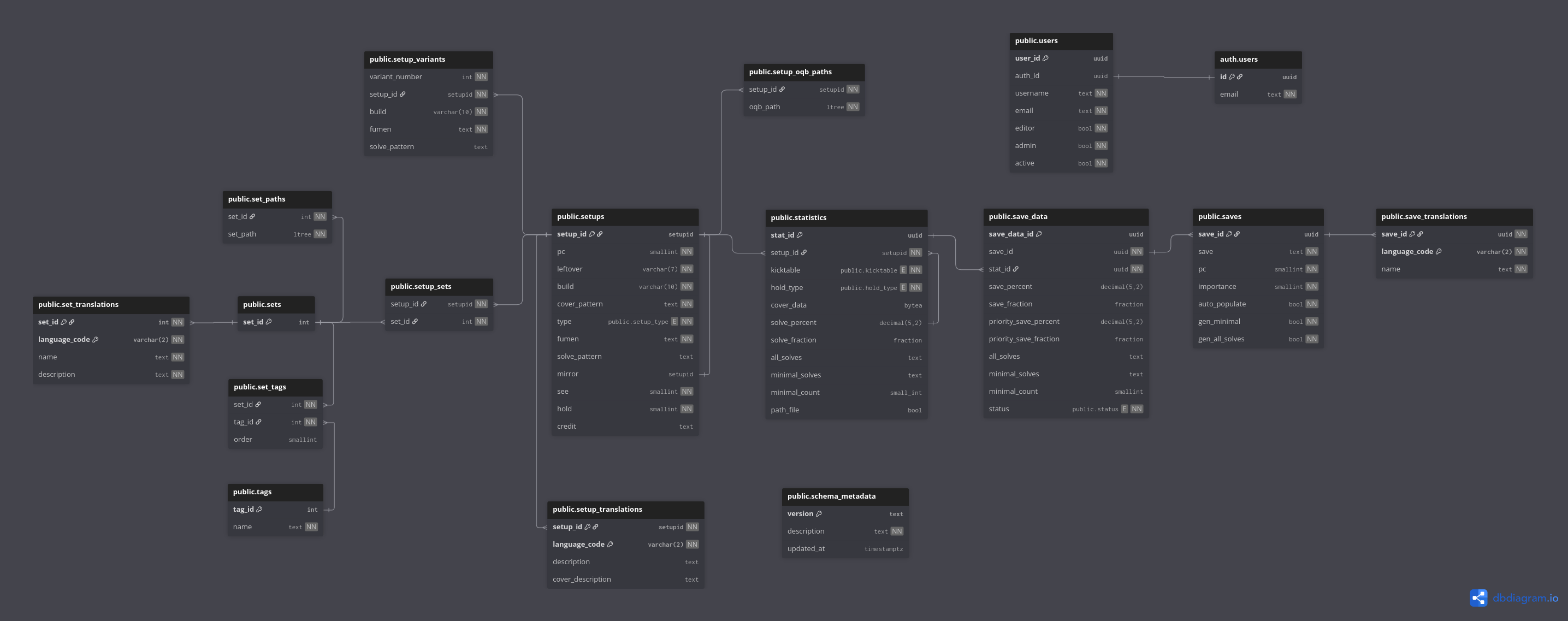
Terminology
| Term | Definition |
|---|---|
| Leftover | Pieces from the bag from the previous PC. Ex: TSZ to solve PCO and have the leftover ILJO on 2nd |
| Build | Pieces within the setup |
| Cover Pattern | Extended pieces stating the when to build the setup. Ex: OQB may need S before Z for next step |
| Solve Pattern | Extended pieces stating what pieces to solve. May be related to cover pattern if cover pattern depends on pieces not in build |
Setup ID
Goals
- Effective order
- Representative of setup
- Uniqueness
Specification

The ID is a packed 48 bit hex string. Ex: 25b2eefaccff
The order of the packed data determines the order and grouping of the setups when sorted. For
this database, the order of TILJSZO is used for pieces.
| Section | Description |
|---|---|
| PC Number | 1-9 value corresponding to 1st to 9th PC |
| OQB | Flag whether the setup is OQB setup |
| Duplicate Piece | Maps duplicate leftover piece to 0-7. No duplicate -> 0, T -> 1, …, and O -> 7 |
| Leftover Pieces | Inverted bitmap of existence of each piece in leftover in TILJSZO order |
| Solve Length | Number of pieces needed to solve. Equivalent to 10 - build length |
| 4x | Flag whether there is 4 duplicate pieces in build |
| Build Pieces | Inverted counts of each piece in build in TILJSZO order with two
bits per piece |
| Fumen Hash | Hash of the fumen into four bits |
| Cover Hash | Hash of the cover pattern into two bits |
| Unique ID | Decrement from 255 in case of collision for uniqueness |
Hashing Functions
def fumen_hash(fumen: str) -> int:
    fumen_encoded = fumen[5:-8].encode() # take reasonably random section
    h = len(fumen_encoded)
    for byte in fumen_encoded:
        h = ((h << 3) | (h >> 4)) & 0x7F # more mixing
        h ^= byte
    return h & 0b1111

def cover_pattern_hash(cover_pattern: str) -> int:
    cover_pattern_encoded = cover_pattern.encode()
    h = len(cover_pattern_encoded)
    for byte in cover_pattern_encoded:
        h ^= byte
    return h & 0b11
These hash functions were based on xor of the characters in the
strings. Modifications were made based on the entropy of the output leading to the above functions.
The cover hash is intended to distribute setups with same values except cover pattern for use case such as QB setups, so entropy is calculated on sets of these kinds of setups. However, there is likely bias as arbitrary modifications were made to increase specifically the entropies of these sets of setups as few sets in original dataset. The entropies were normalized by dividing by the maximium value, which is same as number of bits in hash: 4 for fumen hash and 2 for cover hash.
| Group | Count | Entropy (Normalized) |
|---|---|---|
| All Original Fumens | 4109 | 0.9979379436338721 |
| All One Piece Fumens | 162 | 0.9806935374824224 |
| Setups starting with 50f2eff6f[0-3] | 7 | 0.9751060324573734 |
| Setups starting with 50f2eff6f[4-7] | 7 | 0.9751060324573734 |
Example
| PC Number | Leftover | Build | Cover Pattern | Fumen | OQB |
|---|---|---|---|---|---|
| 2nd | TTIO | TIO | T,[TIO]! | v115@9gwhIewhIewhEewwAeRpwhDeywRpJeAgH | false |
Detailed Conversion
| Section | Description |
|---|---|
| PC Number | 2nd -> 2 = 00102 |
| OQB | Not OQB -> 02 |
| Duplicate Piece | TTIO has T as duplicate piece. T -> 1 = 0012 |
| Leftover Pieces | TTIO has the pieces TIO -> 1st, 2nd and 7th bit unset = 00111102 |
| Solve Length | Build TIO has 3 pieces. 10 - 3 = 7 = 01112 |
| 4x | No 4 duplicate piece in build -> 02 |
| Build Pieces | Build TIO has 1 T, 1 I, and 1 O. Computing bitwise NOT or decrement from 3 gives 102 for TIO subsection and 112 for LJSZ subsection -> 101011111111102 |
| Fumen Hash | Run fumen_hash on the fumen to get 4 = 01002 |
| Cover Hash | Run cover_pattern_hash on the cover pattern to get 1 = 012 |
| Unique ID | No other existing setups in original dataset conflict for first 40 bits -> 255 = 111111112 |
Convert to hex: 0010000100111100111010101111111110010001111111112 -> 213ceaff91ff16
OQB
The oqb_path and oqb_depth help with handling OQB setups. If a setup
is not OQB, oqb_path and oqb_depth are NULL
On insert, the oqb_path may be set to the same value as setup_id to
state setup is OQB. This is only necessary when setting solve_pattern to be NULL for setups that aren't intended to be solve but rather has a next setup.
The oqb_path is automatically populated as a materialized/label path from the setup_oqb_links table that contain the parent/previous setup for each
setup. Similarly, oqb_depth is automatically populated for depth of the setup, equivalently
the number of ancestor setups/nodes.
Cover Pattern
The cover pattern is in extended pieces notation and used to restrict what queues that the setup covers.
The cover pattern does not need to be exactly the correct coverage. The cover_data in
statistics is a bitstring for which queue the setup is covered.
Setup Variants
Some setups, especially one-solve or QB setups, have effectively the same setup but some pieces may be placed before completing the base setup.
In the following image, the first page, page with least number of pieces, is the base setup. To increase the coverage of this setup, the S or O piece can be placed before finishing the base setup. These base setups with extraneous pieces are call variants of the setup.

Statistics Table
Since the values of a setup depends on the kicktable or have 180, this table separates the statistics for each kicktable.
| Kicktable | Definition |
|---|---|
| srs | Super Rotation System from The Tetris Company |
| srs_plus | Tetrio's kicktable: srs with symmetric I spins and 180 |
| srs180 | srs with 180 spins |
| none | No kicks or 180 spins |
| srsx | Tetrio's kicktable: srs with more powerful 180 spins |
| ars | Arika Rotation System |
| arc | Kicktable made for Ascension supported in Tetrio |
| tetrax | Kicktable made for Tetris Legends supported in Tetrio |
Path File
The path_file is a flag whether the path.csv file is stored on the server.
The file is stored with the filename <setup-id>-<kicktable>.csvd.xz,
which is a compressed version of the file.
The basic idea on how to compress the file is to have the fumens keyed by a number then store
the mapping at the beginning. In addition, remove columns that can be computed from the other
columns, which the queues can be compressed into the extended pieces notation that generated it
at the beginning of the file. Then apply xz or the underlying lzma for compression
of the file. This converts the 1-3 MB file into 5-150 KB file.
The following function is the actual implementation.
/**
 * Compress path file
 */
export async function compressPath(filename: string, pieces: string): Result<Buffer> {
  const inputCsv = fs.readFileSync(filename, 'utf-8');
  const records: Record<string, string>[] = parse(inputCsv, {
    columns: true,
    skip_empty_lines: true
  });

  records.sort((a, b) => queueKey(a['ツモ']) - queueKey(b['ツモ']));

  const fumens: Record<string, number> = {};

  for (const row of records) {
    const rowFumens = row['テト譜'].trim().split(';');
    for (let i = 0; i < rowFumens.length; i++) {
      const f = rowFumens[i];
      if (!(f in fumens)) {
        fumens[f] = Object.keys(fumens).length;
      }
      rowFumens[i] = fumens[f].toString();
    }
    row['テト譜'] = rowFumens.join(';');
    row['未使用ミノ'] = mapSaves(row['未使用ミノ']).toString();

    delete row['ツモ'];
    delete row['対応地形数'];
    delete row['使用ミノ'];
  }

  const fumensKeys = Object.keys(fumens);
  const outputLines = [
    pieces,
    '',
    ...fumensKeys,
    '',
    stringify(records, {
      header: true,
      columns: Object.keys(records[0])
    }).trim()
  ];

  try {
    const compressed = await lzma.compress(Buffer.from(outputLines.join('\n')), { preset: 9 });

    // Validate output (though lzma-native should always return Buffer)
    if (!Buffer.isBuffer(compressed)) {
      return { data: null, error: new Error('Compression returned invalid data') };
    }

    return { data: compressed, error: null };
  } catch (err) {
    const error = err instanceof Error ? err : new Error(String(err));
    error.message = `Compression failed: ${error.message}`;

    return { data: null, error };
  }
}
Saves Table
This table is to store save data following the notation used in PC-Saves-Get stored in save column.
Priority save percent/fraction is values in an array of the priority of that save. Ex: T,I,O on 2nd and wanted to know percent of getting T then remaining percent for I then O. This corresponds with the --best-save flag on PC-Saves-Get